

Introduction
Is your freedom of speech truly protected? While the First Amendment prevents government censorship, the landscape of control has changed. Today, the threat isn't a government official knocking on your door; it's a notification that your bank account is frozen or your payment processor has cut you off. This is economic censorship, a quiet but powerful tool used to enforce compliance, similar to issues faced by public libraries. This article explains how this new form of control works and what you can do to protect your freedom of expression. Unlike government actions, corporate censorship is not directly addressed by the First Amendment, which only restricts the government from limiting speech. Legal protections against corporate censorship in the United States are limited, though laws such as antitrust regulations, civil rights statutes, and certain state laws may offer some recourse if discrimination or anti-competitive behavior can be proven. However, private companies are generally free to set their own policies regarding user content and access unless specific legal violations occur.
Free Speech Didn’t Vanish, It’s Just Quietly Controlled
The idea of censorship often brings to mind images of banned books or government officials shutting down newspapers. While those forms of censorship still exist, a more subtle method of censorship has become widespread. Instead of making speech illegal, powerful entities make it financially impossible. Your freedom of speech isn't being erased by law but is being managed through economic pressure, resembling modern methods of censorship.
This shift moves the battleground from the courts to your wallet. We will explore how economic consequences have replaced legal action, how digital platforms facilitate this, and how this pressure effectively silences opinions.
Shifting From Legal to Economic Consequences

Historically, suppressing speech involved legal action. Governments would pass laws, and individuals who violated them could face fines or jail time. This approach was direct and often public. However, the modern method is far less transparent. Today, the consequences for expressing certain views, as seen in how courts and the supreme court interpret regulations, are increasingly economic, a tactic that sidesteps traditional legal protections for free speech.
Instead of a court order, you might find your online business de-platformed by a payment processor. Rather than facing a government official, you could lose your job due to pressure from online mobs or internal policies. This is the core of economic censorship.
It operates in a gray area where private entities enforce their own standards. Because the First Amendment primarily applies to government restrictions, including those imposed by local governments, these private companies can impose significant economic pressure without initiating any formal legal action, creating a powerful tool for controlling speech.
The Rise of Modern Censorship in Digital Societies

The widespread use of social media has created a new arena for censorship in public schools. Platforms like Facebook, Twitter, and YouTube are private entities, not public squares. This means they are not bound by the First Amendment in the same way the government is. They can regulate and restrict speech on their platforms based on their own "community standards" or terms of service.
This gives them immense power to shape public discourse. They can remove content, suspend accounts, or reduce the visibility of certain topics, a practice often labeled as corporate censorship. While these platforms can help stop the spread of fake news websites or harmful content, their rules are often vague and inconsistently applied.
As a result, political censorship can occur under the guise of policy enforcement. Media outlets and individuals who post content deemed "objectionable" can be silenced, not by a government decree, but by a private company's decision to exclude such material.
How Economic Pressure Silences Opinions

How exactly does economic pressure stop someone from speaking their mind? The methods are direct and personal. Imagine being unable to pay your bills because a crowdfunding site shut down your campaign, or losing your livelihood because a payment app terminated your account for "reputational risk." These are not hypothetical situations; they are real economic consequences for expressing a particular freedom of opinion.
This creates a chilling effect on free speech. When people see others facing financial ruin for their views, they become hesitant to share their own opinions. The fear of being unable to support their family is a far more effective silencer than the threat of a distant legal battle.
This form of control undermines basic human rights. The freedom of expression and freedom of the press becomes a privilege for those who can afford the potential economic fallout, rather than a right for everyone. It bypasses the need to maintain public order through law, using financial exclusion instead.
Understanding Economic Censorship as the New Weapon
Economic censorship is the modern battlefield for free speech. Unlike traditional government censorship, which blocks information directly, this new weapon targets your ability to function in the economy and restricts access for the general public. It’s a strategic way to silence dissent by controlling the financial tools you rely on every day. When your access to banking, payments, and fundraising is at risk, you are less likely to express views that powerful groups find objectionable.
This section will define economic censorship, outline its primary methods, and look at real-world examples to show how it is being used globally.
What Is Economic Censorship?
At its core, economic censorship is the use of financial tools and pressure to suppress ideas, information, or individuals. It's one of the most effective forms of censorship because it doesn't need to make speech illegal; it just makes it too expensive to practice. This control is often exerted by private entities like banks, credit card companies, and tech giants, rather than government agencies directly.
This is what makes it different from other types of censorship. Traditional government censorship involves legal restrictions and is subject to constitutional challenges. Corporate censorship, a key part of the economic model, is when private companies use their terms of service to restrict speech.
Financial censorship is the specific mechanism they use: cutting off access to capital, donations, or payment services. It’s a system where financial gatekeepers, not courts, decide what speech is acceptable.
Methods: Frozen Bank Accounts and Payment Restrictions
The tools of economic censorship are integrated into our daily financial lives, making them incredibly effective. The goal is to isolate a target from the economic system, making it difficult to earn a living, raise funds, or even conduct basic transactions. These methods circumvent traditional legal protections for speech.
Some of the most common tactics include:
- Frozen bank accounts: A government or financial institution can freeze personal or business accounts, cutting off access to your own money.
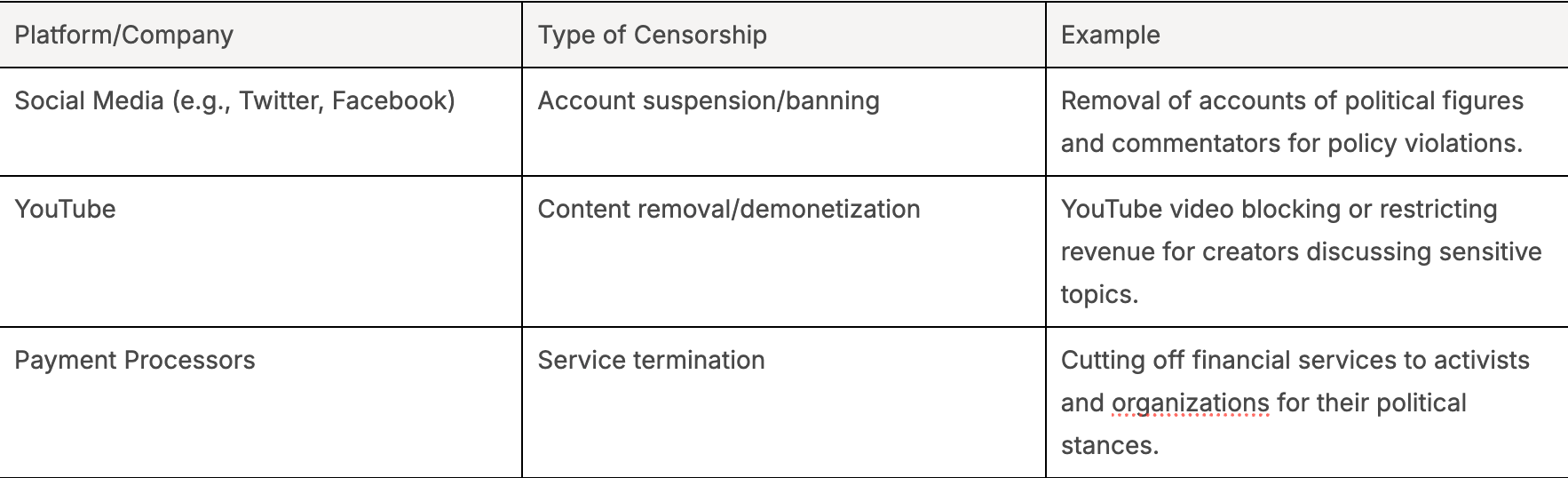
- Payment processor blacklisting: Companies like PayPal, Stripe, or GoFundMe can terminate services for individuals or groups they deem to be in violation of their policies, often with little recourse.
- Demonetization: Content creators can have their revenue streams cut off by platforms like YouTube for discussing controversial topics.
These payment restrictions effectively make it impossible for certain voices to participate in the digital economy. You can protect yourself from frozen bank accounts by diversifying where and how you hold your assets.
Financial Censorship’s Growing Reach

Financial censorship is no longer a fringe issue; its influence is expanding rapidly in our increasingly digital societies. As we rely more on digital platforms for commerce and communication, the companies that control these systems gain more power over what can be said and funded. This creates a direct conflict between our freedom of speech and the authority of financial gatekeepers.
Here, we'll examine this growing conflict, look at cases where fundraising was shut down, and discuss the severe consequences of being placed on a reputational blacklist.
Digital Free Speech Versus Financial Gatekeeping
The promise of the internet was a new era of digital free speech, where anyone could share their ideas with a global audience. However, that promise is being undermined by financial gatekeeping. To participate in the digital economy, whether you're selling a product, running a blog, or raising money for a cause, you need access to payment systems.
This gives financial companies immense power. They have become the de facto regulators of online speech, deciding which activities and ideas are worthy of financial support. If a company like Visa or PayPal decides it doesn't like your cause, it can cut off your economic lifeline with the click of a button.
This creates a chilling effect on freedom of expression and free press. Individuals and organizations may avoid controversial topics, not because they are illegal, but because they fear being financially de-platformed. The New York Times and other outlets have reported on this trend, highlighting the growing tension between free expression and corporate control.
Reputational Blacklists and Their Consequences

One of the most insidious forms of economic censorship is the creation of reputational blacklists. These are informal but powerful lists maintained by banks, payment processors, and other financial entities. If you or your business is flagged for "reputational risk," you can be denied access to essential financial services.
What constitutes a "reputational risk"? The criteria are often vague and subjective. It could be anything from being associated with a controversial political movement to creating a work of art deemed offensive. This lack of clear standards allows for decisions driven by political correctness or public pressure rather than objective risk assessment.
The consequences are severe. Being blacklisted can make it impossible to get a bank account, process credit card payments, or secure a loan. It is a form of economic exile enforced without any legal process, effectively silencing individuals by cutting them out of the modern economy and disrupting public order.
Corporate Censorship: Private Power, Public Impact
While government censorship is limited by law, corporate censorship operates in a different domain. Private organizations, from social media giants to financial institutions, wield immense power to control forms of expression. They are not bound by the First Amendment, allowing them to create and enforce their own rules with significant public impact. This outsourced control has become a primary driver of modern censorship.
This section explains what makes corporate censorship unique, how platform policies define "acceptable" speech, and highlights recent high-profile cases in the news.
What Makes Corporate Censorship Different?

Corporate censorship differs from government censorship in one crucial way: it is carried out by private individuals and entities. The First Amendment in the United States explicitly states that "Congress shall make no law...abridging the freedom of speech." This protection, however, applies to the government, not to private companies.
This legal distinction gives corporations broad authority to regulate speech on their platforms. A social media company can remove posts, a bank can close an account, and a publisher can refuse to print a book without violating constitutional free speech rights. These companies argue they are simply enforcing their terms of service.
However, because these private organizations control the primary channels for modern communication and commerce, their decisions have a massive public impact. The mass media have become the new censors, shaping public discourse and deciding which voices get heard, all without the legal checks and balances that apply to government actions.
Policies, Community Standards, and “Acceptable” Speech
How do corporations justify their censorship? They point to their internal policies, often referred to as "Community Standards" or "Acceptable Use Policies." These documents outline what kind of content, including video games, and behavior is permitted on their platforms. However, these rules are often written in vague and broad terms, giving companies maximum discretion.
Common justifications for removing content or users include:
- Hate Speech: Definitions can be overly broad, censoring legitimate political commentary along with genuine bigotry.
- Misinformation: Companies position themselves as arbiters of truth, often suppressing views that challenge official narratives on controversial topics.
- Harassment: While important for safety, these rules can be weaponized to silence critical opinions by mass-reporting them as harassment.
These policies create a framework where "acceptable" speech is defined not by law but by a corporation's shifting priorities, often influenced by media pressure or political agendas. This erodes the principle of free expression.
High-Profile Cases of Corporate Censorship in the News
Corporate censorship is no longer a theoretical concern; it regularly makes headlines. We've seen numerous high-profile instances where social media platforms and other tech companies have used their power to silence prominent voices, often sparking intense public debate. These actions demonstrate the real-world impact of private content moderation.
Freedom House, an organization that tracks democracy and human rights, has noted the growing power of tech platforms to influence free expression. For example, YouTube video blocking has become a common tool for suppressing content that violates its ever-changing policies.
The Psychological Impact: When Silence Feels Safer

The most effective censorship isn't always loud and forceful. Sometimes, it's the quiet fear that convinces you to stay silent. When the consequences of speaking your mind include losing your job or having your bank account frozen, self-censorship becomes a rational act of self-preservation. This psychological pressure is a hallmark of digital authoritarianism and leads to a profound loss of personal sovereignty.
We will now explore how this fear manifests, the unspoken rules it creates, and its effect on workplace culture.
Self-Censorship in the Age of Digital Authoritarianism
Digital authoritarianism isn't just about government surveillance; it's about creating an environment where citizens police themselves. The constant threat of financial or social punishment for expressing the "wrong" opinion encourages widespread self-censorship. People voluntarily choose not to say or write something, not because they are forced, but because they are afraid of the consequences.
This fear is amplified on social media, where a single controversial post can lead to a digital mob demanding you be fired or de-platformed. For young people especially, who have grown up in this online environment, the pressure to conform is immense.
Instead of engaging in open debate, many people choose to remain silent on important issues. They see what happens to others who step out of line and decide the risk isn't worth it. This voluntary silence is just as damaging to a free society as direct government censorship.
Fear, Unspoken Rules, and Loss of Personal Sovereignty

Economic and corporate censorship fosters a culture of fear. You don't need to be directly threatened to feel its effects. By observing what happens to others, including their use of the internet, you quickly learn the unspoken rules of acceptable discourse. You know which topics are safe and which could get you into trouble at work or online.
This constant low-level fear erodes your sense of personal sovereignty. Instead of freely exercising your freedom of opinion, you find yourself constantly calculating the potential risks of expressing your true thoughts. This is a subtle but profound loss of liberty, where public order is maintained not by law, but by an atmosphere of intimidation.
When you start filtering your thoughts to align with an ever-changing set of acceptable opinions, you are no longer truly free. Your autonomy is given up in exchange for safety and economic stability, a trade that slowly dismantles the foundations of a free society.
Workplace Culture and the Pressure to Conform
This pressure is especially intense in the workplace. Many private organizations have internal policies that govern employee speech, both on and off the clock, to protect the company's brand and uphold First Amendment freedoms. Expressing your own opinions on social media, even on a personal account, can lead to disciplinary action or termination if it's deemed to reflect poorly on your employer.
This creates a workplace culture where employees feel pressured to conform. They may be hesitant to:
- Discuss political or social issues for fear of offending a colleague or manager.
- Challenge company practices, even when they see problems.
- Express personal beliefs that diverge from the corporate consensus.
As the compiled information notes, this can stifle creativity and dissent, leading to groupthink. Employees learn that it's safer to keep their own opinions to themselves, resulting in self-censorship becoming an ingrained part of the professional environment.
CBDCs Explained: The Future of Programmable Money

As we look to the future, a new technology promises to reshape our financial system: Central Bank Digital Currencies, or CBDCs. While promoted as a modern and efficient form of money, CBDCs also introduce the concept of programmable money, which could become the ultimate tool for financial control. Understanding this technology is crucial for anyone concerned with financial freedom and public order.
This section breaks down what CBDCs are, explains the risks of programmable money, and discusses potential strategies to safeguard your financial freedom.
What Are Central Bank Digital Currencies (CBDCs)?
.jpg.png)
A Central Bank Digital Currency (CBDC) is a digital version of a country's official currency. Unlike cash, it would exist only in digital form. Unlike cryptocurrencies like Bitcoin, a CBDC is centralized. It would be issued and controlled by a country's central bank, just like traditional fiat currency. Think of it as a direct digital claim on the central bank.
Proponents argue that CBDCs could make payments more efficient and improve financial inclusion. However, they also shift immense power to the government. With a CBDC, the central bank would have a direct ledger of every transaction made by every citizen.
This technology represents a fundamental change from physical cash, which offers anonymity and finality. The introduction of CBDCs could threaten financial privacy and create new avenues for surveillance and control under the guise of protecting national security.
Programmable Money and Conditional Access
The most significant risk of CBDCs is the potential for programmable money. Because CBDCs are digital and centrally controlled, the money itself can be programmed with rules and restrictions. Government officials could place conditions on how, when, and where you can spend your own money.
Imagine a future where your money could be:
- Set to expire after a certain date to encourage spending.
- Restricted from being used to purchase certain goods, like sugary drinks or firearms.
- Blocked from being donated to political causes the government disapproves of.
- Automatically deducted for fines or taxes without your consent.
This is conditional access. Your ability to use your money would no longer be absolute but could be dependent on your behavior. This technology could be used to enforce public policy and social norms, turning your money into a tool for social engineering and violating fundamental human rights.
Risks, Rewards, and Financial Freedom Strategies
The primary reward of CBDCs is efficiency for the state, offering greater control over the economy and law enforcement. For citizens, the risks to financial freedom are immense. A CBDC could create a system where every transaction is monitored and potentially controlled by the government. It represents the final step in the erosion of financial privacy.
So, how can you protect yourself? Financial freedom strategies in a world with CBDCs will revolve around diversification. This means not relying solely on the financial system of a single country. Exploring assets outside the traditional banking system, such as physical precious metals or decentralized cryptocurrencies, may become more important.
Resisting this level of control requires proactive planning. Individuals may need to structure their finances globally to ensure that no single government has the power to turn off their access to money. This is a key part of challenging and resisting this new form of censorship.
Escaping Economic Cages: Sovereignty and Solutions
The rise of economic and political censorship feels overwhelming, but you are not powerless. The solution is to intentionally structure your life to reduce your dependence on any single system. By building financial sovereignty, you can escape the economic cages being built around us. This involves diversifying your assets, income, and legal ties across different jurisdictional frameworks.
Here, we will outline practical strategies for diversifying your life, present concrete steps to regain personal sovereignty, and provide a framework for jurisdictional diversification.
Diversifying Residency, Assets, and Income Streams
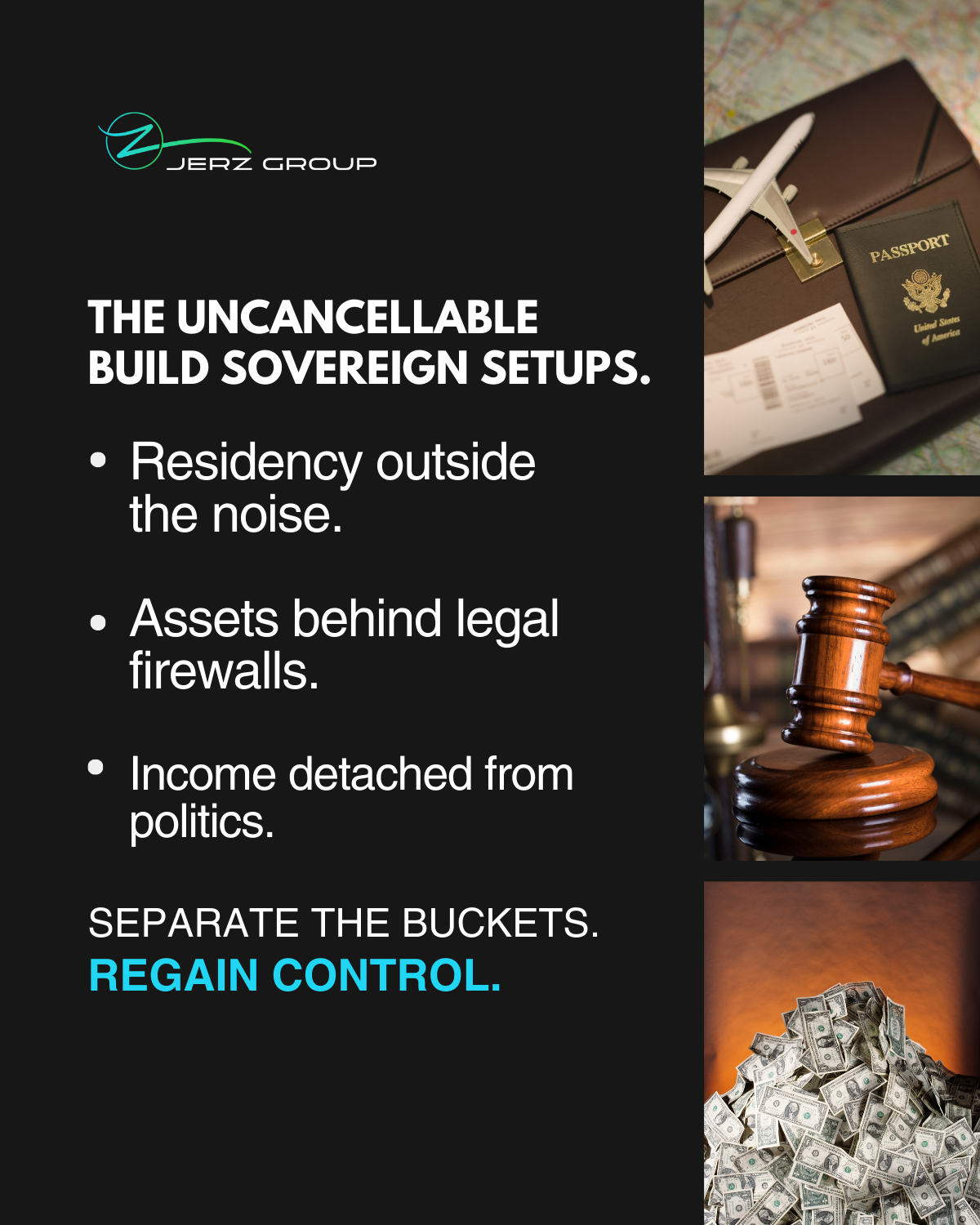
The core principle of escaping economic control is diversification. If all your assets, your only source of income, and your citizenship are all tied to one country, you are completely exposed to its rules and political whims. If that country implements CBDCs or aggressive financial censorship, you have no recourse.
Diversifying means spreading your risk across national borders. Asset diversification involves holding wealth in different countries and in different forms, such as foreign real estate, international stocks, or precious metals stored abroad.
Income diversification means building income streams that are not tied to a single employer or country, such as a remote business that serves global clients. Finally, diversifying your residency by obtaining a second passport or foreign residency gives you a legal escape hatch: a place to go where you are treated better.
Steps to Regain Personal Sovereignty
Regaining personal sovereignty is an active process of reducing your dependency on systems that seek to control you. It’s about making conscious choices that increase your freedom and resilience. This is not just for the ultra-wealthy; anyone can take practical steps to become more sovereign.
Here are some actionable steps to consider:
- Open an offshore bank account: Holding some funds outside your home country protects you from local political and economic risks, including sudden account freezes.
- Acquire a second passport or residency: This provides a legal right to live, work, and bank in another country, giving you an essential backup plan.
- Own real assets: Physical assets like real estate or precious metals cannot be deleted with a keystroke and exist outside the digital financial system.
These steps help restore a balance of power, ensuring your fundamental human rights, like freedom of religion and expression, are not contingent on compliance.
Jurisdictional Diversification: A Practical Framework
Jurisdictional diversification is a strategic framework for organizing your life and assets across multiple countries to maximize freedom and security. The goal is to ensure that no single government has total control over you. You can choose the best legal protections, tax systems, and lifestyle options from different places.
For example, you might be a citizen of one country, a legal resident of another with low taxes, bank in a third country with strong financial privacy, and run your business from a fourth with a favorable corporate environment.
This approach leverages the fact that we live in a world of competing national borders. By planting flags in different jurisdictions, you create a robust personal structure that is resilient to political censorship, economic turmoil, and the erosion of freedom. It is the ultimate strategy for thriving in an era of increasing control.
Follow Jerz


